Domain vs Hosting vs Website: The Plain-English Guide for Ghanaian Businesses
Domain, hosting and website are three separate things doing three separate jobs, and confusing them is why a paid-for domain can still show a blank page. Here is the difference in plain English, plus the renewal trap and ownership question every Ghanaian business should check.
If you've paid for a domain and you're staring at a blank page wondering why your website still isn't online, here's the short answer: a domain on its own is just an address. Nothing shows up there until you've also got hosting and an actual website sitting behind it. You didn't get cheated, and nothing is broken. You've bought one of three things you need, and the other two haven't been put in place yet.
The reason this trips up so many business owners is that "domain," "hosting," and "website" get used as if they're the same thing, when they're three separate purchases that do three separate jobs. Once you can see how they fit, the whole thing stops being confusing, and you stop being at the mercy of whoever set it up for you.
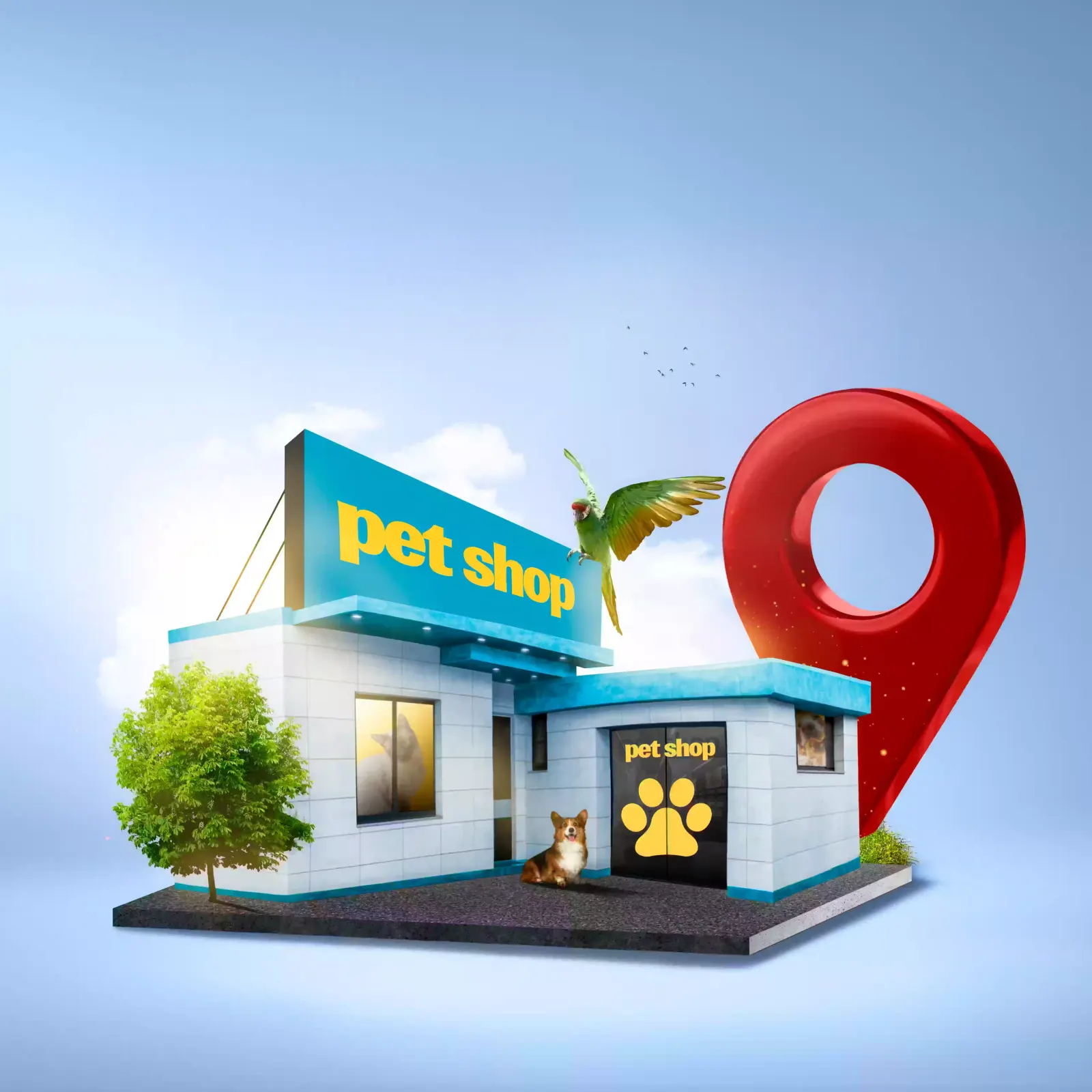
The cleanest way to picture it is a physical shop.
The domain is your shop's address. It's how people find you. "yourbusiness.com" is the signboard and the street name people type to reach your door.
The hosting is the land and the building. It's the actual space where your shop physically exists, the plot and the structure standing on it.
The website is everything inside. Your products on the shelves, your branding, the layout, the counter, the experience a customer has once they walk in.
Take any one away and there's no shop. An address with no building is a sign pointing at an empty lot. A building with nothing inside is four bare walls. A beautifully stocked shop with no address is a place nobody can find.
Hosting is the land and the building — the servers where your website's files actually live.
What a domain name actually is
A domain name is your website's address on the internet. Instead of asking customers to remember a long string of numbers (the IP address that computers actually use to find each other), they just type something human:
yourbusiness.com — the global standard, what most businesses reach for first.
yourbusiness.com.gh — the Ghanaian extension, a clear signal that you're a registered local business.
yourcompany.africa — a continental option, good for a brand that wants to read as pan-African.
yourngo.org — the convention for nonprofits and organisations.
Behind the scenes, the domain's job is to point. When someone types your address, the domain quietly tells their browser which server to go and fetch your site from. That pointing is handled by something called DNS, the internet's address book. You don't need to understand the plumbing. You just need to know that the domain is the name and the directions, not the website itself.
A few things worth knowing if you're registering one in Ghana. A regular .com is cheap and instant, usually a few hundred cedis a year. A .com.gh is run by the Ghana Network Information Centre under NITA, costs more (in the region of GHS 590 a year at the time of writing), and asks for proof that you're a real registered business in Ghana. That extra step is a feature, not a hassle, because it means a .com.gh carries a bit of "this is a legitimate local company" weight that a .com doesn't.
The domain is the name and the directions. It is not the website itself.
What web hosting actually is
If the domain is the address, hosting is the land and the building your shop stands on. Web hosting is rented space on a server, a computer that stays switched on and connected to the internet every hour of every day, holding all the files that make up your site: the text, the images, the code, the database behind it.
When someone visits your address, the hosting server is what actually hands over your pages so their browser can show them. No hosting, no building, nowhere for the website to live. That's exactly why a domain alone leaves you with a blank page. You bought the sign. You haven't rented the land yet.
Hosting is also where a decision quietly gets made that most owners never realise they made: how fast your site feels. A cheap, overloaded server far away will crawl on a mid-range Android over mobile data, which is how most of your customers in Ghana will actually visit you. Hosting chosen and configured properly is one of the biggest reasons a site loads in a second instead of making someone wait and leave. It isn't just "somewhere to keep the files." It's part of the experience.
What the website actually is
The website is everything inside the shop. It's the part your customer actually sees and uses: the pages, the words, the photos, the branding, the layout, the contact form, the WhatsApp button, the whole experience of being "in" your business online.
This is the piece people usually mean when they say "I need a website," and it's the piece that takes real work to get right. A domain you can register in five minutes. Hosting you can switch on in an afternoon. The website, the thing that has to actually convince a stranger to trust you and get in touch, is where the design, the writing, and the engineering go. It's why two businesses can pay for the same domain and the same hosting and end up with one site that wins customers and one that just sits there.
So when you put the three together: the domain brings people to the door, the hosting holds the building up, and the website is the reason they're glad they came in.
How the three work together
Here's the full journey in plain English. A customer types your domain. The domain points their browser to your hosting server. The server hands back your website's files. Their phone assembles those files into the pages they see. All of that happens in well under a second when it's set up well.
The simplest way to keep them straight:
What it is
Shop analogy
Who you pay
What happens if it lapses
Domain
Your web address
The address / signboard
A domain registrar
Your site and email go dark; the name can be lost
Hosting
Server space for your files
The land and building
A hosting company
Your files have nowhere to live; the site disappears
Website
The pages and content
Everything inside the shop
Whoever builds it (once)
Nothing to show, even with the other two in place
One important thing this table makes obvious: these are three separate things you can buy from three separate places. You can register your domain at one company, host with another, and have a third build the site. They don't have to be bundled. That's worth knowing, because it means you're never trapped, you can move your hosting to a faster provider next year and keep the exact same domain and website. You own the address; you're only renting the land.
"So why isn't my website online?"
Back to the question that probably brought you here. If you've bought a domain and there's still nothing there, it's almost always one of these five, and none of them mean you did something wrong:
You haven't got hosting yet. The most common one. You have the address but no building behind it. Nothing can show until there's a server holding your files.
The domain isn't pointed at the hosting. You have both, but the domain hasn't been told where to send people. This is a DNS setting, a five-minute job for whoever set things up.
It's still propagating. You just pointed the domain, and that change is rippling out across the internet's address books. It usually takes minutes, but can take up to 48 hours to fully settle everywhere.
The website hasn't been built or uploaded. Hosting is on, the domain points correctly, but the building is empty. There are no pages there yet to show.
The site isn't connected to your domain. Your website exists, but it's parked on a temporary address and was never wired up to the proper one you bought.
Notice that every one of these is a setup step, not a fault. A domain going live is a small chain of connections, and a blank page just means one link in the chain hasn't been made yet.
You're renting, not buying: the renewal trap
Here's the part nobody warns Ghanaian business owners about, and it catches good companies every year. You don't own your domain forever. You rent it, usually one year at a time, and you have to renew it. Miss the renewal and the consequences are brutal, fast, and very public.
The moment a domain lapses, your website goes offline. If your business email runs on that domain (yourname@yourbusiness.com), every email to you starts bouncing. Then the clock starts. There's a short grace period, then a redemption period where you can still get the name back but at a much steeper fee. After that, the name is released, and anyone in the world can register it. A competitor. A stranger. Someone who then asks you to buy your own name back at ten times the price, if they're willing to sell at all.
You don't own your domain forever. You rent it, and the day you forget to renew is the day your name is up for grabs.
This isn't rare. Businesses lose the domain they spent years building reputation on because one renewal email went to an inbox nobody checks, or the person who originally set it up has moved on. The fix is simple: know when your domain renews, keep the payment details current, and ideally have one accountable partner whose job is to make sure that date never sneaks up on you.
Who actually owns your domain? Check this today
This one is worth stopping for, because it's the quiet trap that does the most damage in Ghana. When a developer or a "guy who does websites" sets everything up for you, ask one question: whose name is the domain registered under?
Too often, the answer is theirs, not yours. They registered your domain in their own account, under their own details, and as far as the records are concerned, they own your business's name on the internet, not you. As long as the relationship is good, you'll never notice. The day there's a disagreement, or they stop responding, or they want more money, you discover you can't move your site, can't renew the domain yourself, and can't prove the name is yours. You're effectively held hostage by your own address.
Protect yourself. Your domain should be registered in your business's name, with your email as the contact, in an account you can log into. The same goes for your hosting. You can absolutely let someone manage it all for you, that's normal and sensible, but managing it on your behalf and owning it instead of you are two very different things. If you're not sure which one you have right now, that's exactly the thing to find out this week.
How to do it right
You don't need to become a technical expert to get this right. You need three things in place, owned by you, and ideally looked after by someone who won't disappear:
Register the domain in your own name. Your business, your email, your account. Choose the extension that fits, a .com for reach, a .com.gh for clear local credibility, and put the renewal date somewhere you'll see it.
Choose hosting that fits how Ghana actually browses. Fast on a mid-range phone over mobile data, reliable, and secure. This is a real decision, not a checkbox, and it's a big part of whether your site feels quick or sluggish.
Build the website properly. This is the part customers judge you on, so it's the part worth doing well rather than dragging out of a template. It's also the one you only build once and then improve over time.
This is the work we do for businesses every day. We design and build the website itself, and we handle the hosting and maintenance behind it, including the renewals, the security, and keeping the site fast, so the domain never quietly expires and the building never falls down. One accountable partner, everything owned by you.
And if you've read this far still not sure what you actually have, who owns your domain, or why your page is blank, the quickest way to get clarity is just to ask.
The bigger picture is that the domain and hosting are the cheap, simple part. The website is where the real value is, and where the real cost sits too. If you want a clear, honest breakdown of what a website really costs in Ghana and the running costs most quotes never mention, that's the natural next read.
Key takeaways
A domain is your address, hosting is the land and building, the website is everything inside. You need all three.
A domain alone won't show a website. A blank page usually means hosting, DNS, or the site itself isn't in place yet.
You rent a domain, you don't own it forever. Miss a renewal and your site and email go down, and the name can be lost for good.
Make sure your domain and hosting are registered in your name, not your developer's. Managing it for you is fine; owning it instead of you is not.
You can mix providers and move hosts freely, your domain and website come with you.
Discussion
0 comments
No comments yet. Be the first to share your thoughts.
Leave a comment
Thanks — your comment is awaiting moderation.
It will appear here once a member of our team approves it.
What a website really costs in Ghana in 2026, broken down by the type of site you are buying and the tier of person who builds it, from a student to a full agency, plus the running costs no quote mentions.
Off-the-shelf or custom? For a growing Ghanaian business, choosing wrong in either direction is expensive. An honest comparison of cost, fit, ownership, and ROI — with a decision matrix and the signals that mean it is time to build.




Discussion
0 comments
No comments yet. Be the first to share your thoughts.
Leave a comment
Thanks — your comment is awaiting moderation.
It will appear here once a member of our team approves it.